Getting someone to click an advertisement, search result, email, or social post feels like progress. However, a click alone does not generate revenue.
Digital marketing really starts paying off when that click becomes a meaningful customer conversation.
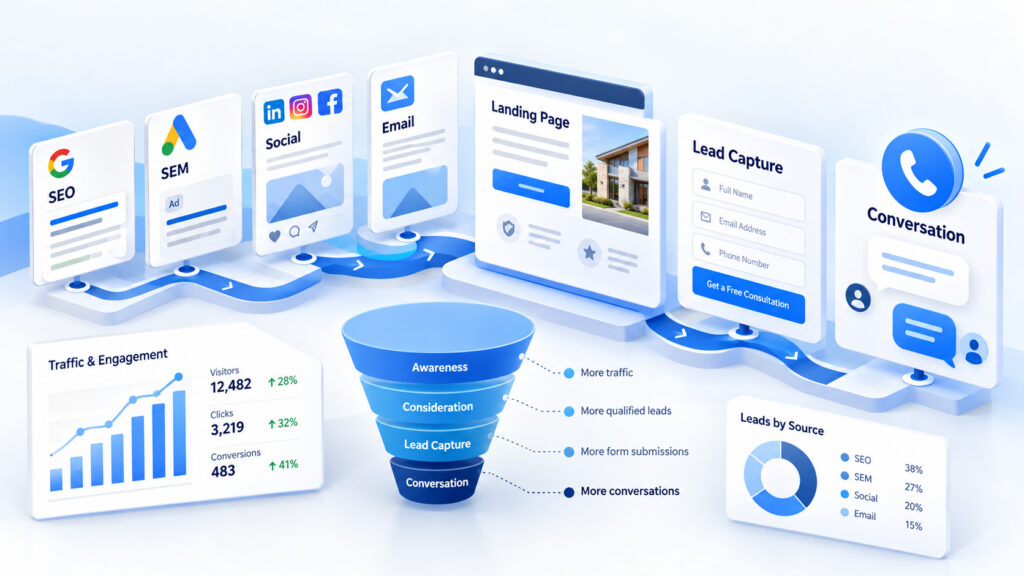
Therefore, successful companies connect SEO, SEM, social media, email marketing, landing pages, lead generation, and human follow-up into one customer journey.
Each channel has a different purpose. However, every channel should move the customer closer to action.
Search engine optimization often introduces potential customers to a business before anyone speaks with them.
Customers search because they need information, solutions, products, or services. Therefore, appearing during those moments creates valuable opportunities.
According to Semrush's 2026 traffic channel study, organic search generated more than one trillion website visits during 2025.
However, generating website traffic should never become the final goal.
Instead, SEO content should guide visitors toward a call, form submission, consultation, purchase, appointment, or another meaningful action.
Consequently, businesses should measure what visitors do after they arrive.
While SEO builds long-term visibility, search engine marketing helps businesses reach prospects actively searching for solutions.
However, paid traffic continues becoming more expensive.
A 2026 Search Engine Land analysis of 2025 Google Ads benchmarks reported higher average costs per click across most industries. Conversion rates improved at the same time.
Therefore, companies cannot simply buy more clicks.
Instead, every advertisement should connect customer intent with a relevant landing page and compelling next step.
Furthermore, Google's landing page optimization guidance recommends matching advertisements, keywords, landing pages, and calls to action.
That consistency reduces friction while improving the path toward conversion.
Meanwhile, social media creates opportunities earlier in the customer journey.
People discover companies, compare options, watch videos, read comments, ask questions, and investigate brands through social platforms.
According to the 2025 Sprout Social Impact of Social Media Marketing report, marketing leaders increasingly connect social media with customer acquisition and revenue.
However, posting more content does not automatically create better results.
Instead, businesses need useful content connected to clear conversion opportunities.
Those opportunities might include landing pages, phone calls, direct messages, downloadable resources, consultations, or lead forms.
Once customers click, the landing page becomes one of the most important parts of the digital marketing customer journey.
Visitors should immediately understand what the business offers and why they should take action.
In addition, the page should make contacting the business simple.
Google recommends placing clear contact options prominently on landing pages and ensuring pages closely match the advertisements that brought visitors there.
Therefore, strong landing pages should remove unnecessary distractions.
Forms should also collect enough information to enable useful follow-up without creating unnecessary friction.
However, capturing the lead only solves half the problem.
Someone still needs to engage that prospect.
Not every customer converts immediately.
Consequently, email marketing can continue the conversation after someone downloads information, requests details, or shows interest.
HubSpot's updated lead nurturing guidance emphasizes delivering the right message to the right person with an appropriate next step.
However, email automation should support human conversations rather than replace them entirely.
When someone replies, clicks repeatedly, requests pricing, or demonstrates buying intent, the business needs an effective response process.
Otherwise, marketing generated attention without generating momentum.
This stage separates digital activity from actual business growth.
Marketing may generate the lead. A CRM may capture it. Automation may send another message.
Nevertheless, someone eventually needs to start a meaningful conversation.
Salesforce's 2026 State of Marketing research found that 83% of marketers say customers increasingly expect two-way conversations.
Meanwhile, 69% say they struggle to respond promptly.
That gap creates a significant opportunity.
Fast phone outreach, SMS, email responses, lead qualification, appointment setting, and persistent follow-up can transform digital interest into sales opportunities.
Additionally, human representatives can answer questions, understand concerns, address objections, and determine what customers actually need.
Technology creates efficiency. However, people create relationships.
Ultimately, SEO, SEM, social media, email marketing, landing pages, lead generation, and follow-up should never operate independently.
They should function as one connected growth system.
SEO creates discovery. SEM captures intent. Social media creates engagement. Landing pages capture opportunities. Email keeps prospects engaged.
Then, human follow-up turns interest into conversation.
At EagleONE, that means connecting digital marketing with lead generation, lead management, sales support, and customer experience.
Because ultimately, businesses do not need more disconnected clicks.
They need better customer journeys.