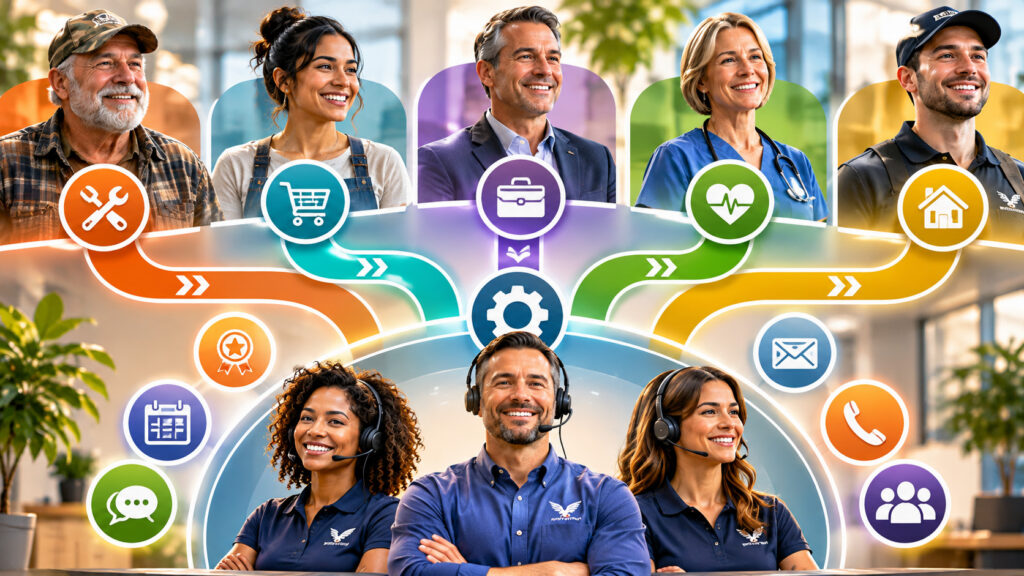
Businesses spend considerable resources attracting customers, yet many undermine those investments by treating everyone exactly the same. Consequently, customers receive identical messages, standardized responses, and generic follow-ups regardless of their individual needs.
While consistency matters, one-size-fits-all customer service often creates an experience that feels impersonal, predictable, and disconnected.
Customers want businesses to recognize their circumstances, understand their preferences, and respond appropriately. Furthermore, they expect interactions that reflect their history rather than treating every conversation like the first.
The challenge isn't delivering completely different experiences to everyone. Instead, businesses must understand meaningful customer differences and use that knowledge to provide more relevant service.
Standardized customer service promises efficiency, consistency, and predictable operating costs. However, identical treatment doesn't necessarily produce equally satisfying experiences.
Consider two customers contacting a home services company. One needs emergency repairs, while another wants information about routine maintenance.
Sending both customers through identical communication processes ignores their different priorities. Consequently, one customer may experience unnecessary delays while the other receives irrelevant urgency.
According to Salesforce's 2025 State of Service Report, organizations increasingly combine AI and human expertise to deliver faster, more personalized interactions.
Therefore, businesses must recognize that consistent service standards shouldn't require identical customer experiences.
The goal isn't treating every customer the same. It's making every customer feel equally important.
Customer segmentation organizes customers into groups based on shared characteristics, behaviors, preferences, or purchasing patterns.
Rather than creating thousands of individual service strategies, businesses can develop practical approaches for customers with similar needs.
For example, companies might distinguish first-time buyers, repeat customers, high-value accounts, inactive customers, and customers requiring immediate assistance.
Additionally, businesses can segment customers according to purchasing history, communication preferences, service requirements, or relationship maturity.
A 2025 McKinsey analysis of personalized marketing highlights how customer segmentation supports more relevant engagement throughout the customer lifecycle.
Consequently, businesses can deliver targeted communication without unnecessarily complicating their operations.
Many organizations assume personalized service requires larger teams, additional technology, and greater operating expenses.
However, effective customer segmentation can actually simplify communication and reduce unnecessary interactions.
For instance, automated systems can identify customer categories and trigger appropriate messages, reminders, or follow-up sequences.
Meanwhile, customer experience representatives can access relevant information before beginning conversations.
As a result, employees spend less time gathering basic details and more time solving problems.
Furthermore, businesses can develop standardized workflows for specific customer segments rather than creating unique processes for every individual.
A 2025 McKinsey article on AI-powered customer experiences explores how contextual information can help organizations determine appropriate customer interactions.
The important distinction involves standardizing the process while personalizing the experience.
Customer expectations naturally change throughout the purchasing relationship. Therefore, effective personalization requires understanding where each customer stands.
New prospects often need education, reassurance, and answers to basic questions. Conversely, established customers generally expect convenience, familiarity, and efficient problem resolution.
Meanwhile, dissatisfied customers may require empathy, immediate attention, and meaningful recovery efforts.
Businesses that recognize these differences can tailor their communication accordingly.
For example, a new customer might appreciate an introductory email explaining available services. However, a longtime customer might prefer recommendations based on previous purchases.
Similarly, inactive customers may respond better to thoughtful outreach than another generic promotional message.
Ultimately, relevant communication demonstrates that a business understands its customers beyond their transaction history.
Technology makes personalized customer service more scalable, but automation alone cannot create meaningful relationships.
Customer relationship management systems, intelligent routing, and behavioral insights help businesses recognize preferences and anticipate needs.
Nevertheless, human judgment remains essential when conversations involve frustration, uncertainty, complicated decisions, or emotional concerns.
According to Zendesk's 2026 Customer Experience Trends Report, released in November 2025, customers increasingly expect responsive, contextual, and personalized service.
Therefore, successful organizations combine intelligent technology with employees who can interpret circumstances and respond appropriately.
Importantly, personalization also requires responsible data practices, accurate customer information, and respect for individual preferences.
Effective customer segmentation isn't about giving certain customers better treatment while neglecting everyone else.
Instead, it ensures every customer receives the attention, information, and support appropriate to their circumstances.
Businesses should begin with a few meaningful segments, establish relevant communication workflows, and measure customer satisfaction and retention.
Additionally, regularly reviewing customer feedback helps organizations refine their approach without creating unnecessary operational complexity.
Ultimately, personalized customer experience shouldn't represent a luxury reserved for premium customers.
It should become a practical operating philosophy that combines efficiency, relevance, and genuine human understanding.
Because when every customer receives the same treatment, nobody feels particularly important.